Showing posts with label exhibition. Show all posts

Friday, 5 July 2013

Final Minor Inspiration

Lisa Merida-Paytes
The daughter of a taxidermist, ceramic artist Lisa Merida-Paytes was surrounded by unusual sights when she was growing up: hanging carcasses and freezers full of animal hides were common to her surroundings. So it comes as no surprise that her artwork reflects what surrounded her as a kid. She uses her ceramic work to come to terms with the graphic imagery of her childhood. In her words, she tries “to evoke the animal spirit that was once destroyed and to make amends for the discord and waste".


Christopher David White
White is a ceramics artist. This piece is called Cycle of Decay. His impeccably detailed ceramic sculpture is particularly impressive as it looks like petrified wood, even on close inspection the knotted and twisting veins of the tree branch look almost exactly like old wood.


Polly Morgan
Morgan is a taxidermy artist, she uses animals that are road casualties or are donated to her by pet owners. Morgan's work explores preserving animals that would have otherwise decomposed.


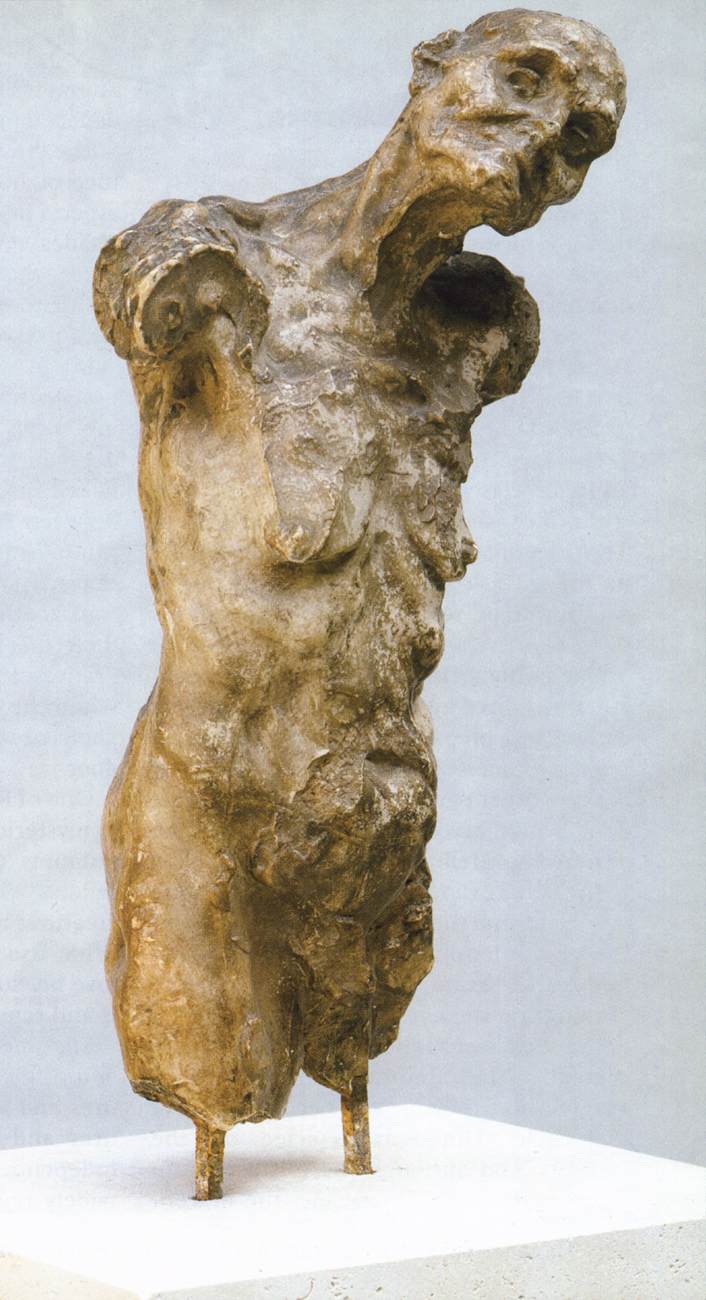
Camille Claudel
Torso of Clotho. Clotho is the youngest of the Three Fates or Moirai, in ancient Greek mythology. She was responsible for spinning the thread of human life. This highly impressive plaster is one of Claudel's most unusual figures: a haggard old woman, well marked by physical decay, her body is skin and bones.


Manuel Martí Moreno
Sculptor Manuel Martí Moreno lives and works in Valencia, Spain and forms these wonderful
figurative pieces out of iron nuts. Via email Moreno says that he is most interested in showing the passage of time, the transience of life, and our collective awareness of our own mortality, seemingly evidenced by the spectre of decay at the edges of his works. 


Kate McDowell

In her delicate crafted porcelain sculptures conceptual artist Kate McDowell expresses her interpretation of the clash between the natural world and the modern-day environmental impact of industrialized society. The resulting works can be equal parts amusing and disturbing as the anatomical forms of humans and animals become inexplicably intertwined in her delicate porcelain forms. Via her artist statment:

In my work this romantic ideal of union with the natural world conflicts with our contemporary impact on the environment. These pieces are in part responses to environmental stressors including climate change, toxic pollution, and gm crops. They also borrow from myth, art history, figures of speech and other cultural touchstones. In some pieces aspects of the human figure stand-in for ourselves and act out sometimes harrowing, sometimes humorous transformations which illustrate our current relationship with the natural world. In others, animals take on anthropomorphic qualities when they are given safety equipment to attempt to protect them from man-made environmental threats.


Thursday, 4 July 2013

Antony Gormley - Public Art

Antony Gormley is widely acclaimed for his sculptures, installations and public artworks that investigate the relationship of the human body to space. His work has developed the potential opened up by sculpture since the 1960s through a critical engagement with both his own body and those of others in a way that confronts fundamental questions of where human being stands in relation to nature and the cosmos. Gormley continually tries to identify the space of art as a place of becoming in which new behaviours, thoughts and feelings can arise. 


Gormley's work has been widely exhibited throughout the UK and internationally with exhibitions at Centro Cultural Banco do Brasil, São Paulo, Rio di Janeiro and Brasilia (2012); Deichtorhallen, Hamburg (2012); The State Hermitage Museum, St Petersburg (2011); Kunsthaus Bregenz, Austria (2010); Hayward Gallery, London (2007); Malmö Konsthall, Sweden (1993) and Louisiana Museum of Modern Art, Humlebæk, Denmark (1989). He has also participated in major group shows such as the Venice Biennale (1982 and 1986) and Documenta 8, Kassel, Germany (1987). Permanent public works include the Angel of the North (Gateshead, England), Another Place (Crosby Beach, England), Inside Australia (Lake Ballard, Western Australia) and Exposure (Lelystad, The Netherlands).


Gormley was awarded the Turner Prize in 1994, the South Bank Prize for Visual Art in 1999 and the Bernhard Heiliger Award for Sculpture in 2007. In 1997 he was made an Officer of the British Empire (OBE). He is an Honorary Fellow of the Royal Institute of British Architects, an Honorary Doctor of the University of Cambridge and a Fellow of Trinity and Jesus Colleges, Cambridge. Gormley has been a Royal Academician since 2003 and a British Museum Trustee since 2007. Antony Gormley was born in London in 1950. 

Tuesday, 18 June 2013

Long Road Exhibition Review


Year 13 work differs from year 12 work in the fact that it is much more specialised to each person. Each student has chosen something that they wish to pursue.


Nicola Baley - F12
Nicloa's work interested me because I like the way she has studied animals. I like the style in which she draws and paints. Her photographs are also very interesting.


Kate Kelly - F20
Kate's work interested me because I really like her style of painting and the realistic outcome of her pieces despite the fact that she often uses unrealistic colours. The only criticism I have is that some of her works are transcriptions of other artists works rather than her own ideas.


I looked at various students sketchbooks and some of the artists that they had researched. The artists that particularly interested me and that I would like to explore further are: Kay Goodridge, Polly Morgan, Edward Sutcliffe, Tai-shan, Paul Wright, Nick Richards and Leonardo Da Vinci.

It is clear that the research of other artists work has had an influence on the development of the students practical work. Some students have directly taken inspiration from the work and have done transcriptions. Other students have taken inspiration from the artists they have studied but have only been influenced by them and have developed ideas of their own.

Ana d'Escrivan-Nott is a student at Long Road Sixth Form College who is not studying the National Art Diploma. I really like a set of etchings that she did. Her Etchings are architectural studies on painted backgrounds.