Showing posts with label college. Show all posts

Friday, 5 July 2013

Final Minor Inspiration

Lisa Merida-Paytes
The daughter of a taxidermist, ceramic artist Lisa Merida-Paytes was surrounded by unusual sights when she was growing up: hanging carcasses and freezers full of animal hides were common to her surroundings. So it comes as no surprise that her artwork reflects what surrounded her as a kid. She uses her ceramic work to come to terms with the graphic imagery of her childhood. In her words, she tries “to evoke the animal spirit that was once destroyed and to make amends for the discord and waste".


Christopher David White
White is a ceramics artist. This piece is called Cycle of Decay. His impeccably detailed ceramic sculpture is particularly impressive as it looks like petrified wood, even on close inspection the knotted and twisting veins of the tree branch look almost exactly like old wood.


Polly Morgan
Morgan is a taxidermy artist, she uses animals that are road casualties or are donated to her by pet owners. Morgan's work explores preserving animals that would have otherwise decomposed.


Camille Claudel
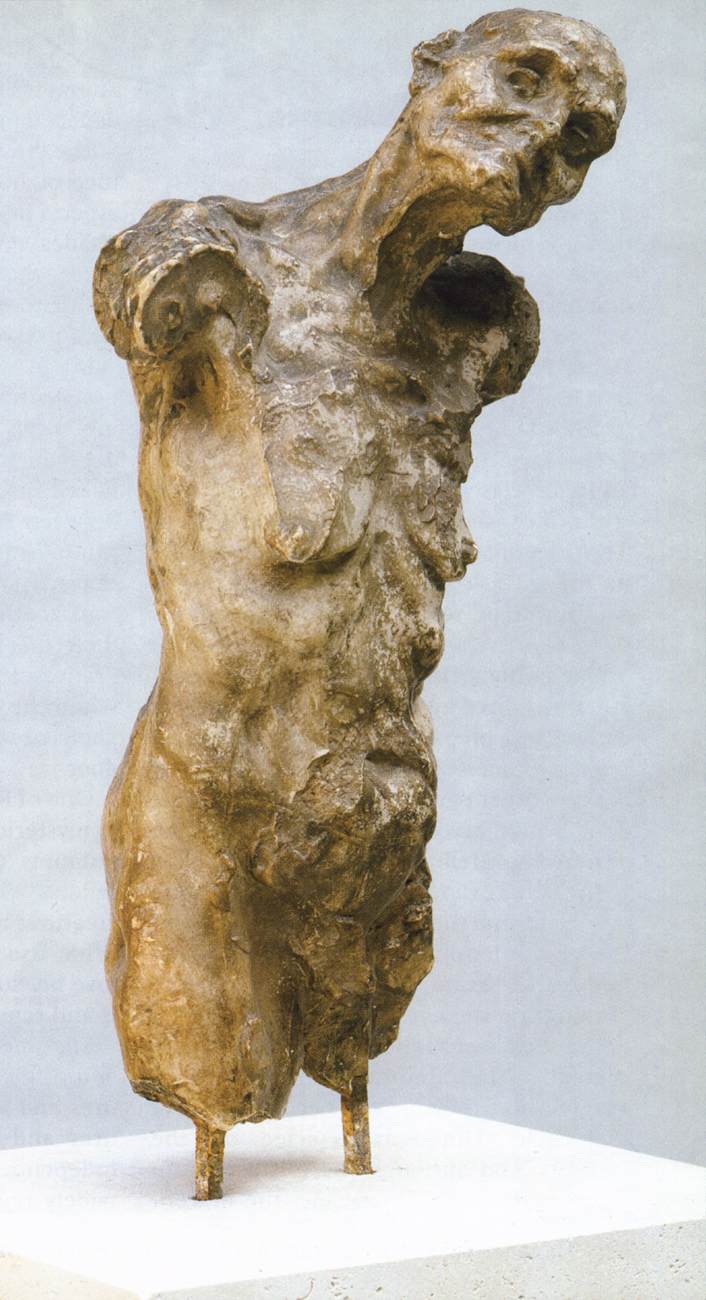
Torso of Clotho. Clotho is the youngest of the Three Fates or Moirai, in ancient Greek mythology. She was responsible for spinning the thread of human life. This highly impressive plaster is one of Claudel's most unusual figures: a haggard old woman, well marked by physical decay, her body is skin and bones.


Manuel Martí Moreno
Sculptor Manuel Martí Moreno lives and works in Valencia, Spain and forms these wonderful
figurative pieces out of iron nuts. Via email Moreno says that he is most interested in showing the passage of time, the transience of life, and our collective awareness of our own mortality, seemingly evidenced by the spectre of decay at the edges of his works. 


Kate McDowell

In her delicate crafted porcelain sculptures conceptual artist Kate McDowell expresses her interpretation of the clash between the natural world and the modern-day environmental impact of industrialized society. The resulting works can be equal parts amusing and disturbing as the anatomical forms of humans and animals become inexplicably intertwined in her delicate porcelain forms. Via her artist statment:

In my work this romantic ideal of union with the natural world conflicts with our contemporary impact on the environment. These pieces are in part responses to environmental stressors including climate change, toxic pollution, and gm crops. They also borrow from myth, art history, figures of speech and other cultural touchstones. In some pieces aspects of the human figure stand-in for ourselves and act out sometimes harrowing, sometimes humorous transformations which illustrate our current relationship with the natural world. In others, animals take on anthropomorphic qualities when they are given safety equipment to attempt to protect them from man-made environmental threats.


Thursday, 27 June 2013

Aid & Abet

We had quest speakers Sarah Evans and CJ Mahony from Aid & Abet (an artist run space in Cambridge). 
Aid & Abet is an artist-led contemporary art space.  It was co-founded by Sarah Evans, David Kefford and CJ Mahony in 2009 and is based in a large warehouse near the railway station in Cambridge.
Aid & Abet supports artists to experiment, take risks and innovate as well as collaborate, engage and network. Aid & Abet is a production and presentation site for contemporary art that combines work, project, gallery and performance space allowing audiences and participants to engage with cross-disciplinary practises in both creative and critical ways.
Aid & Abet is part of the CB1 programme for public art in Cambridge’s new City quarter near the Station Road area and is supported by Commissions East, Brookgate and Hill Residential.
Aid & Abet have artists work from all over the UK, whose artworks have started to be installed across the site.
CB1 have commissioned four artists to make work: David Ward, Antoni Malinowski, Jem Finer and Dryden Goodwin.

David Ward's instillation was a temporary art piece, installed in 2011. It was two films, projected one above the other, simultaneously record the elaborate traceries of King's College Chapel's fan-vault ceiling. The piece, titled The Analysis Of Beauty, is typical of David Ward's muted yet monumental instillations.


Antoni Malinowski's instillation is a permanent piece. He attached small pieces of glass to the wall of the Aid & Abet building. This piece is very subtle, people often walk by without even noticing that the installation is there, until the light catches the pieces of glass. Malinowski is very interested in light and movement which are two key elements to this installation. Antoni has identified the overwhelming characteristics of Cambridge as the medieval rhythms of the Gothic architecture and the micro- rhythms woven into the architectural details which energize and animate the larger rhythms of brick and stone.


Jem Finer's installation is in the process of developing a new artwork for Cambridge CB1 station area

entitled Supercomputer as part of the programme for public art. Supercomputer is a functioning computer made from a series of pipes, it will be enclosed in a glass fronted pavilion, similar to the mainframe computers of the 1970’s. Supercomputer will be designed to play pitched percussive instruments incorporated in the structure, in effect turning the computer into a composing calculator creating new compositions over a 179 year period. The sounds generated by the sculpture will be relayed through a speaker system incorporated in the pavilion’s structure, which will be activated at certain points of the day.


.


Dryden Goodwin's work is to be installed in 20--. 'Wander' consists of 100 etched steel plates laid into the paving. Inspired by a series of drawings collected by the artist round Cambridge. 

The dispersal of the plates means that visitors and local residents may only see some of the plates, but will discover previously unnoticed etchings over a period of time as they further explore the site.